On June 4, 1996, the Ariane 5 rocket—Europe’s flagship launch vehicle—exploded 37 seconds after liftoff. The $370 million rocket and its $500 million payload were destroyed. The cause: a software bug that had existed in the Ariane 4 codebase for years but only manifested under Ariane 5’s different flight profile.
The bug was a 64-bit floating point number being converted to a 16-bit signed integer without proper range checking. Under Ariane 4’s trajectory, the value never exceeded the integer’s range. Under Ariane 5’s faster acceleration, it did. The overflow triggered an exception, which propagated through backup systems, causing total flight control failure.
Here’s the economics puzzle: Why wasn’t this caught in testing?
Because it was difficult to reproduce in the test environment. The exact timing, sensor values, and flight profile that triggered the bug didn’t occur during ground testing. Engineers ran thousands of simulations. The bug never manifested. Until it did—catastrophically—during the first production flight.
This illustrates a recurring pattern in complex systems: bugs that are difficult to reproduce often incur disproportionately higher investigation and resolution costs.
The Cost Structure of Non-Reproducible Bugs
Industry surveys suggest that software debugging consumes 35-50% of total development time. For safety-critical systems, it can exceed 60%. But not all debugging effort is equal.
Reproducible Bugs: The Baseline
A reproducible bug follows a relatively predictable cost curve:
- Detection (1-2 hours): Bug report filed with reproduction steps
- Localization (2-8 hours): Engineer traces execution to identify root cause
- Fix (2-4 hours): Code change to address root cause
- Verification (2-4 hours): Test that fix resolves the issue
- Total: 7-18 hours at $200-300/hour fully loaded = $1,400-$5,400 per bug (indicative)
This is manageable. The engineer has a clear path: reproduce the bug, inspect state, identify the fault, fix it, verify the fix works.
Non-Reproducible Bugs: The Cost Amplifier
A Heisenbug—a bug that disappears when you try to observe it—has a markedly different cost profile:
- Detection (1-2 hours): Bug report filed, often with incomplete reproduction steps
- Attempted reproduction (8-40 hours): Engineers try to recreate conditions that trigger the bug
- Speculative debugging (20-80 hours): Without reproduction, engineers add logging, insert breakpoints, modify code—each change potentially altering the timing that caused the bug
- Exploratory fixes (10-40 hours): Engineers implement fixes based on hypothesis, which may or may not address the root cause
- Regression testing (10-30 hours): After each exploratory fix, extensive testing to check if the bug reappears
- Escalation (5-20 hours): Senior engineers or external consultants brought in when initial attempts fail
- Total: 54-212 hours = $10,800-$63,600 per bug (indicative)
Observed cost impact: Frequently several-fold higher than comparable reproducible defects.
And this assumes the bug is eventually fixed. In practice:
- A significant percentage of Heisenbugs are never definitively resolved; teams implement workarounds or accept residual risk
- Many “fixes” address symptoms rather than root causes, potentially leading to related issues later
- Some bugs recur in production despite being marked “fixed” in development
Note: Cost figures throughout this article are indicative estimates based on published industry discussions and engineering surveys. Actual costs vary significantly by organisation, system complexity, and development context.
The Opportunity Cost
Beyond direct engineering hours, non-reproducible bugs can impose opportunity costs:
Delayed features: Engineers debugging may not be available for new capabilities. Extended debugging efforts can delay feature delivery.
Schedule risk: Non-reproducible bugs create uncertainty. Programs may add schedule margin to account for debugging overruns, potentially delaying market entry.
Team dynamics: Hunting Heisenbugs can be frustrating. Engineers may spend extended periods on low-progress work, which can affect productivity.
Technical debt: Exploratory fixes often add code complexity. Workarounds for non-reproducible bugs can accumulate, making the codebase harder to maintain.
Why Non-Determinism Can Amplify Debug Cost
Non-reproducible bugs are expensive because reproducibility is a foundational requirement for applying hypothesis-driven debugging methods reliably.
The Scientific Method and Reproduction
Effective debugging typically follows hypothesis-driven investigation:
- Reproduce the failure
- Hypothesize a cause
- Test the hypothesis (add instrumentation, modify code)
- Verify the fix resolves the issue
Each step benefits from reproduction. Without it:
- Verifying hypotheses becomes difficult
- Testing whether fixes work becomes uncertain
- Distinguishing signal from noise becomes challenging
Engineers may resort to:
- Code inspection: Reading thousands of lines hoping to spot the bug
- Broad debugging: Making multiple changes simultaneously, hoping one helps
- Heuristic fixes: “This pattern often causes problems, so let’s change it”
None of these approaches provide high confidence. The bug might be fixed. Or it might manifest differently. Or it might still exist but not have occurred in recent tests.
Race Conditions: A Common Challenge
Race conditions—bugs caused by timing-dependent execution order—are among the most common and challenging Heisenbugs.
Example: Two threads access shared memory without proper synchronization. Thread A reads a value. Thread B modifies it. Thread A uses the now-stale value. Depending on scheduler timing, this can cause:
- Corrupted data structures
- Incorrect calculations
- System crashes
- Security vulnerabilities
In development, engineers run the code thousands of times. It usually works. Occasionally it fails—but when they add logging to diagnose the failure, the logging changes timing and the bug may disappear. The Heisenberg principle in action: observation can alter the phenomenon.
A Deterministic Replay Approach
Deterministic execution addresses the reproduction challenge directly. Given identical initial state and input sequence, execution is designed to be reproducible. Bugs are less likely to disappear when observed. They can reproduce more consistently.
How Replay Works
- Checkpoint system state at tick boundaries
- Record all external inputs (sensor data, user commands, network packets)
- On failure, save checkpoint + input sequence
- Replay from checkpoint with identical inputs → designed to produce identical execution → same failure
Engineers gain reproducibility:
- Bug can manifest consistently on replay
- Can add detailed logging without altering execution timing
- Can step through code with debugger without timing changes
- Can verify fixes more confidently—if replay no longer fails, evidence that bug is addressed
The Potential Cost Impact
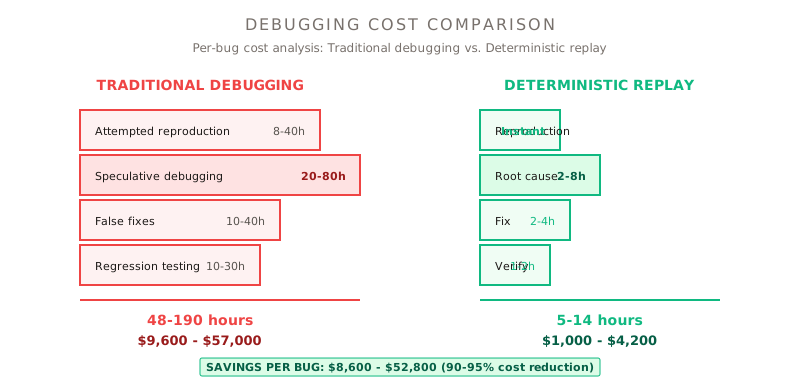
Deterministic replay can change debugging economics:
- Attempted reproduction: 8-40 hours
- Speculative debugging: 20-80 hours
- Exploratory fixes: 10-40 hours
- Regression testing: 10-30 hours
- Total: 48-190 hours (indicative)
- Reproduction: Near-instant (replay from checkpoint)
- Root cause analysis: 2-8 hours
- Fix implementation: 2-4 hours
- Verification: 1-2 hours (replay confirms fix)
- Total: 5-14 hours (indicative)
Indicative per-bug impact: Often an order-of-magnitude reduction in engineering effort when replay is available, based on reported case studies.
Illustrative Case Studies
The following scenarios illustrate how reproducibility can affect debugging economics in different domains.
Case Study 1: Autonomous Vehicle Perception
Scenario: Perception system occasionally misclassifies objects. Bug occurs infrequently during testing. Safety-relevant—requires investigation before production.
Traditional debugging approach:
- Extensive test driving attempting to trigger the bug
- Code inspection and hypothesis testing
- Multiple exploratory fixes
- Additional regression testing
- Significant engineering investment with residual uncertainty
Deterministic replay approach:
- Capture sensor data and system state when bug occurs
- Replay from checkpoint → bug reproduces consistently
- Root cause identified: floating point precision issue under specific conditions
- Fix implemented and verified through replay
- Substantially reduced investigation time with higher confidence in fix
Case Study 2: Medical Device Firmware
Scenario: Medical device occasionally exhibits unexpected behaviour. Occurs rarely. Requires investigation for regulatory approval.
Traditional debugging:
- Extensive simulation and physical testing to reproduce
- Analysis of interrupt handling and timing
- Multiple exploratory fixes with safety testing after each
- Additional documentation for regulatory review due to uncertainty
- Extended timeline with residual concerns
Deterministic replay:
- Record execution state when issue occurs
- Replay in lab → reproduces consistently
- Root cause identified: timing-dependent interrupt handling
- Fix verified through extensive replay testing
- Reduced investigation time with stronger evidence for regulatory review
Case Study 3: Avionics System
Scenario: Flight control system experiences transient fault. Occurred once in extensive flight hours. Requires investigation.
Traditional debugging:
- Extensive simulation and hardware-in-loop testing
- Analysis of sensor fusion and control algorithms
- Multiple firmware revisions with flight testing
- Extended regulatory review due to uncertainty
- Substantial cost and schedule impact
Deterministic replay:
- Flight data recorder captured execution trace
- Replay in lab → fault reproduces
- Root cause identified: sensor data timing dependency
- Fix verified through extensive scenario replay
- Potentially accelerated regulatory review due to reproducible evidence
- Reduced overall investigation and certification timeline
Schedule and Time-to-Market Considerations
Beyond direct debugging costs, non-reproducible bugs can affect product schedules.
Schedule Uncertainty
A single Heisenbug can introduce schedule uncertainty:
Discovery timing: Heisenbugs often appear during integration or system testing when multiple components interact—close to scheduled release.
Unpredictable resolution: Teams may struggle to estimate how long a Heisenbug will take to resolve. Schedule risk compounds.
Regression considerations: Each exploratory fix might require extensive re-testing, adding time to the schedule.
Certification implications: For safety-critical systems, unresolved transient faults can complicate certification discussions.
The Value of Reduced Uncertainty
Time-to-market can have significant financial implications:
Aerospace: Program delays can affect revenue timing, continued development costs, and competitive positioning.
Automotive: Vehicle launch timing affects market share, model year alignment, and tooling costs.
Medical devices: Approval timing affects clinical trial costs, competitive positioning, and opportunity costs.
Deterministic debugging can help reduce schedule uncertainty by:
- Shortening investigation cycles
- Reducing uncertainty around defect resolution timelines
- Potentially supporting more efficient certification discussions
Implementation Considerations
Adopting deterministic replay requires platform support:
Technical Requirements
Tick-based execution: State transitions occur at discrete tick boundaries, enabling checkpoint/replay.
Event recording: External inputs (sensors, user commands, network data) recorded at tick granularity.
State capture: System state serializable for checkpointing—typically 1-10MB per checkpoint depending on application complexity.
Storage: Recording infrastructure for execution traces. Modern systems can store hours of detailed traces.
Operational Integration
Development workflow: Engineers replay failures in debuggers with full symbol information, stepping through execution with high fidelity.
Continuous integration: Automated tests can capture execution traces. Failed tests include replay data, enabling reproduction.
Field diagnostics: Production systems can record execution traces. Field issues can be analyzed in lab via replay.
Regulatory submissions: Execution traces can provide objective evidence of system behavior for certification discussions.
Potential Benefits
Organizations that adopt deterministic debugging may gain advantages in several areas:
1. Development Efficiency
Reduced debugging time can accelerate:
- Feature delivery (less time investigating defects)
- Integration cycles (fewer integration issues)
- Release confidence (higher certainty in quality)
2. Product Quality
Deterministic replay can enable:
- Root cause fixes rather than symptomatic patches
- More comprehensive test coverage (replay enables testing of rare conditions)
- Higher confidence in production reliability
3. Total Cost of Ownership
Engineering cost reductions can compound over product lifecycles:
- Initial development savings
- Maintenance efficiency
- Reduced field support escalations
4. Regulatory Efficiency
Certification discussions may benefit from deterministic systems:
- Reproducible evidence can support approval discussions
- Potentially reduced test case requirements
- Stronger evidence for fix verification
Conclusion
The accumulated evidence suggests that reproducibility can significantly alter the cost structure of debugging in complex systems.
For organisations developing safety-critical or highly concurrent software, deterministic replay represents a structural approach for reducing investigation cost, schedule risk, and post-deployment uncertainty.
The Ariane 5 incident—and numerous similar cases across industries—illustrate the potential consequences when bugs are difficult to reproduce. While deterministic execution is not the only approach to improving debugging economics, it addresses one of the fundamental challenges: the ability to reliably reproduce and investigate failures.
For teams building systems where debugging cost and schedule predictability matter, understanding how execution determinism affects these economics can help inform architectural decisions early in the development process.