Note: This article discusses architectural approaches that can support ISO 26262 compliance. It does not provide legal, regulatory, or certification advice. Actual certification outcomes depend on system context, implementation details, assessor interpretation, and comprehensive safety analysis. Organizations pursuing certification should work directly with qualified functional safety consultants and certification bodies.
The ASIL-D Challenge
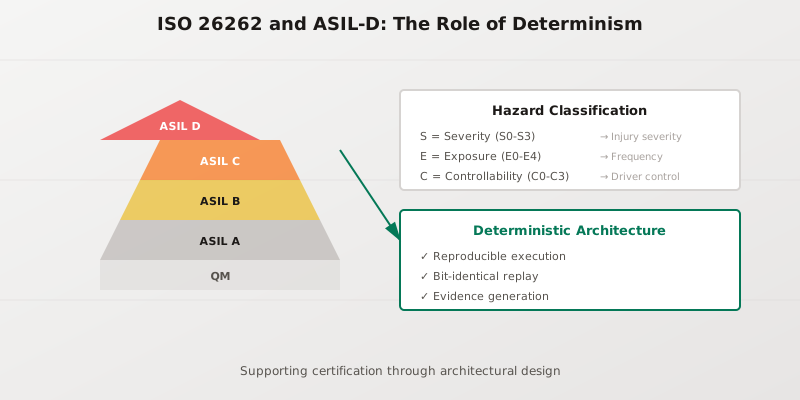
ISO 26262 defines four Automotive Safety Integrity Levels (ASIL A through D), with ASIL D representing the highest classification of hazard and requiring the most stringent safety measures. Systems like airbags, anti-lock brakes, and power steering typically require ASIL D classification because the risks associated with their failure are potentially fatal.
ASIL classification is determined through Hazard Analysis and Risk Assessment (HARA), evaluating three factors: Severity of potential injury, Exposure to operational conditions where the hazard could occur, and Controllability by the driver to prevent harm. A combination of the most severe ratings across these factors results in ASIL D classification.
The challenge facing automotive safety engineers is straightforward: ASIL D requires the highest level of assurance that dependent safety goals are sufficient and have been achieved. This assurance must be demonstrated through rigorous verification, validation, and evidence generation throughout the development lifecycle.
Where Nondeterminism Creates Certification Risk
Traditional automotive E/E architectures face a fundamental challenge during certification: the behavior of nondeterministic systems can vary between executions, even with identical inputs. This variability introduces specific risks during the ISO 26262 certification process.
Verification Complexity
The standard specifies safety requirements that are more rigorous at higher ASIL levels in order to achieve the required lower likelihood of dangerous failures. When system behavior includes nondeterministic elements such as thread scheduling variations, interrupt timing dependencies, or floating-point optimization differences, verification becomes challenging.
Consider a critical safety function that must respond within defined timing bounds. In a nondeterministic system, the actual response time may vary based on scheduler decisions, cache states, or interrupt patterns. Demonstrating that the system meets its timing requirements under all possible execution paths becomes an evidence problem: how do you prove consistent behavior when the system itself doesn’t behave consistently?
Evidence Generation Challenges
ISO 26262 determines requirements for validation, verification, and confirmation measures to ensure a sufficient and acceptable level of safety being achieved. These measures depend fundamentally on the ability to collect meaningful evidence about system behavior.
In nondeterministic systems, test results may vary between runs. A test that passes in one execution might fail in another, not because the system changed, but because the underlying execution path differed. This phenomenon, known as flaky testing, undermines confidence in the verification process and makes it difficult to demonstrate that safety requirements have been met consistently.
Post-Incident Analysis Requirements
ISO 26262 uses a risk-based approach where hazards are assessed and safety measures are defined to avoid or control systematic failures and to detect or control random hardware failures or mitigate their effects. When an incident occurs during testing or field operation, understanding what happened requires the ability to reconstruct the exact sequence of events.
Nondeterministic systems make reconstruction challenging. If you cannot reliably reproduce the conditions that led to a failure, you cannot definitively determine whether the failure resulted from a systematic error in the design or from an environmental factor. This ambiguity creates risk during certification assessments.
How Deterministic Architecture Can Support Certification
Deterministic computing platforms are designed to produce bit-identical results for identical inputs, eliminating execution path variability. This architectural property can support several aspects of the ISO 26262 certification process.
Under defined conditions, a deterministic system executing the same input sequence produces identical outputs and identical internal state transitions, enabling precise verification of safety requirements.
Verification Benefits
With deterministic execution, verification testing becomes more tractable. A test that validates a safety function’s behavior represents not just one execution path, but all execution paths for that input sequence. This property can reduce the verification burden by eliminating the need to account for scheduling variations, cache state differences, and other sources of nondeterministic behavior.
For timing analysis, deterministic systems provide clearer bounds. Worst-case execution time analysis becomes more precise when the scheduler behavior is deterministic and when there are no hidden variables affecting execution timing.
Evidence Quality
Deterministic platforms can generate higher-quality evidence for certification assessments. Test logs from deterministic systems represent reproducible facts about system behavior rather than samples from a distribution of possible behaviors. When an assessor reviews verification evidence, deterministic execution provides stronger assurance that the tested behavior matches the deployed behavior.
ISO 26262 highly recommends the use of semi-formal modeling languages for ASIL D designs, with executable validation using either prototyping or simulation being mandatory. Deterministic execution supports this requirement by ensuring that simulation results directly correspond to actual system behavior.
Incident Investigation
When issues arise during development or field operation, deterministic systems enable precise reconstruction of events. Given the same initial state and input sequence, the system will traverse the same execution path, allowing engineers to understand exactly what happened and why. This capability supports root cause analysis and helps distinguish between systematic design errors and environmental factors.
Architectural Considerations for Determinism
Supporting ISO 26262 certification through deterministic architecture requires attention to several design elements.
Deterministic Scheduling
The scheduler must make consistent decisions based on defined priority schemes rather than incorporating timing-dependent or random elements. Fixed-priority scheduling with well-defined preemption rules provides predictable behavior that can be analyzed and verified.
Elimination of Hidden State
Sources of nondeterminism such as uninitialized variables, timing-dependent race conditions, or hardware-dependent cache behavior must be addressed at the architectural level. The system should expose all relevant state explicitly so that verification tools can reason about system behavior comprehensively.
Bounded Execution Paths
All system operations should have defined completion bounds. Unbounded loops, unlimited retry mechanisms, or timing-dependent polling introduce variability that complicates verification. Deterministic architectures typically enforce resource bounds that make all execution paths analyzable.
Formal Verification Support
For ASIL D, ISO 26262 highly recommends semi-formal methods. Deterministic systems are more amenable to formal verification techniques because their behavior can be modeled completely. The absence of nondeterministic elements means that model checking and theorem proving tools can provide stronger guarantees about system properties.
Integration with Safety Mechanisms
Deterministic architecture is designed to complement rather than replace traditional safety mechanisms required by ISO 26262. The standard defines requirements for hardware and software safety mechanisms at the system level.
Deterministic execution can enhance these mechanisms. For example, watchdog timers become more reliable when system timing is predictable. Redundancy and voting schemes produce more meaningful results when comparing outputs from deterministically-executed functions. Diagnostic routines can detect anomalies more accurately when normal behavior is consistent.
The Murray Deterministic Computing Platform (MDCP) demonstrates this integration approach by providing deterministic kernels that can host safety-critical functions while maintaining compatibility with ISO 26262 verification requirements. Similarly, CardioCore shows how deterministic principles apply to medical device certification under related standards like IEC 62304.
Real-World Application Patterns
Organizations pursuing ASIL D certification while leveraging deterministic architecture typically follow certain patterns:
Incremental Adoption
Rather than requiring full system determinism, teams often start by making safety-critical functions deterministic while accepting nondeterministic behavior in non-safety-critical components. This approach allows them to gain certification benefits where they matter most while managing development complexity.
Evidence-First Development
With deterministic execution enabling precise evidence generation, development processes can emphasize evidence collection from the start. Every test run produces reproducible evidence that can directly support certification documentation.
Continuous Verification
The reproducibility properties of deterministic systems support continuous integration and verification. Automated test suites can run with confidence that passing results represent genuine safety requirement satisfaction rather than fortunate scheduling outcomes.
Limitations and Trade-offs
Deterministic architecture is designed to support certification, not guarantee it. Several considerations remain:
The standard evaluates entire systems, not just computation platforms. Even with deterministic execution, factors such as sensor quality, actuator response characteristics, hardware reliability, and system integration all influence certification outcomes.
Determinism adds design constraints. Systems must be architected to avoid nondeterministic patterns, which may require different approaches than conventional embedded development. This can affect development timelines and team training requirements.
ISO 26262 uses a risk-based approach where assessors evaluate whether implemented measures adequately address identified hazards. Assessor interpretation plays a significant role, and different certification bodies may have varying perspectives on the value of deterministic architecture in meeting standard requirements.
Strategic Perspective
For organizations developing ASIL D automotive systems, deterministic architecture represents a design choice that can address specific certification challenges. It does not eliminate the need for rigorous safety engineering, comprehensive hazard analysis, or robust testing practices. Rather, it provides architectural support for these activities by making system behavior more predictable and verifiable.
The decision to pursue deterministic architecture should be based on system requirements, development constraints, and certification strategy. Organizations should evaluate whether the verification benefits and evidence quality improvements align with their specific safety goals and regulatory context.
As with any architectural approach, suitability depends on system requirements, risk classification, and regulatory context. Teams should work with qualified functional safety consultants to determine whether deterministic architecture supports their certification objectives.