Note: The cost estimates and financial figures discussed in this article are indicative based on industry patterns and published research. Actual costs vary significantly depending on organization size, domain, system complexity, and development practices. These figures should not be used as the basis for specific investment decisions without conducting organization-specific analysis.
The Iceberg Problem
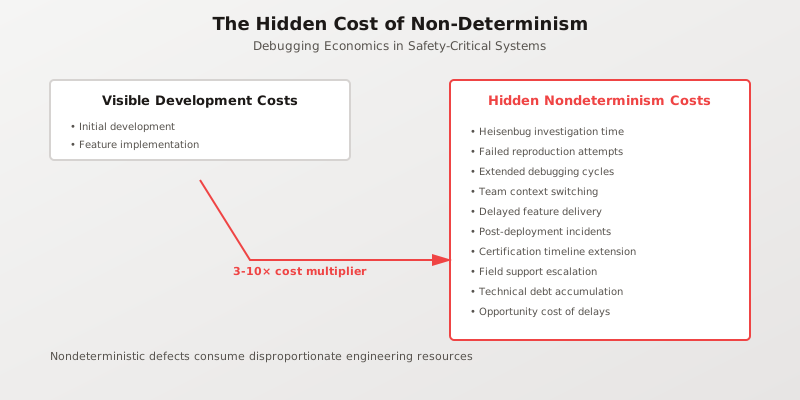
When a CFO reviews a software project’s budget, they typically see line items for development, testing, and deployment. What they don’t see is the disproportionate cost hidden beneath the surface: the engineering time consumed by nondeterministic defects that resist conventional debugging approaches.
Nondeterministic bugs, often called Heisenbugs, are defects whose behavior changes or disappears when you attempt to study them. They arise from race conditions, timing dependencies, uninitialized variables, and other sources of execution variability. Unlike deterministic bugs that can be reliably reproduced and fixed, these elusive defects can consume weeks or months of senior engineering time.
The financial impact is rarely captured in project accounting. Organizations track “development costs” and “testing costs” but seldom isolate the specific overhead attributable to nondeterministic behavior. Yet this hidden cost can be substantial enough to affect project ROI, market timing, and competitive position.
Understanding the Cost Structure
The economics of nondeterministic debugging differs fundamentally from conventional defect resolution. A typical deterministic bug might follow this pattern: discover the issue, reproduce it reliably, identify the root cause, implement a fix, verify the correction. Total time: hours to days.
A nondeterministic defect follows a very different trajectory.
Investigation Time Multiplication
When engineers encounter a Heisenbug, the first challenge is simply determining that they’re dealing with nondeterministic behavior rather than environmental factors or user error. This triage phase can consume significant time as teams attempt various reproduction strategies.
Once identified as nondeterministic, the debugging process becomes probabilistic. An engineer might spend days attempting to reproduce a race condition that manifests only under specific timing circumstances. Adding logging to understand the issue may alter the timing enough that the bug disappears, a phenomenon that can lead to false confidence that the problem has been resolved.
Research on debugging effectiveness suggests that nondeterministic defects can require three to ten times more investigation effort than comparable deterministic issues. This multiplier reflects not just direct debugging time but also the cognitive overhead of reasoning about multiple possible execution paths and the frustration of working with unreliable reproduction.
Context Switching Overhead
Heisenbugs rarely follow a linear debugging path. An engineer begins investigating, hits a reproduction failure, switches to other work, then returns when the bug resurfaces. Each context switch carries cognitive overhead as the engineer re-establishes mental models of the code, the suspected failure mode, and the debugging strategy.
In organizations with multiple ongoing projects, nondeterministic issues can pull senior engineers away from planned work repeatedly as bugs resurface in production or testing environments. The opportunity cost of this disruption compounds the direct debugging time cost.
Verification Challenges
Once a fix is implemented for a nondeterministic defect, verification becomes problematic. How do you confirm that a race condition has been eliminated? Running the test suite once and seeing success proves little when the original issue manifested intermittently.
Teams often resort to stress testing, running the same scenarios hundreds or thousands of times to gain statistical confidence. This verification burden adds time to the fix-deploy cycle and requires additional infrastructure for reliable stress testing environments.
Domain-Specific Cost Amplification
The financial impact of nondeterministic debugging varies by domain, with safety-critical systems experiencing particularly severe cost amplification.
Aerospace and Automotive Systems
In aerospace or automotive contexts governed by standards like DO-178C or ISO 26262, nondeterministic behavior creates certification risk. A bug that cannot be reliably reproduced is difficult to analyze for safety implications. The investigation must not only identify the root cause but also demonstrate that all related scenarios have been addressed.
Certification timelines in these domains can extend by months when nondeterministic issues arise late in development. Given that certification delays typically cost organizations in the range of hundreds of thousands to millions per month in delayed revenue and continued development expenses, even a single stubborn Heisenbug can have substantial financial implications.
Medical Device Development
IEC 62304 Class C medical device software faces similar challenges. Post-market incidents involving nondeterministic behavior can trigger regulatory actions, field corrections, and potential litigation exposure. The cost of a single post-deployment Heisenbug in a medical device context can exceed the entire development budget when you factor in investigation, regulatory response, field updates, and potential liability.
Financial Trading Systems
In high-frequency trading or transaction processing systems, nondeterministic behavior can have immediate P&L impact. A race condition that causes order mispricing or double execution represents both direct financial loss and regulatory exposure. The cost of such issues is measured not in engineering hours but in trading losses and potential regulatory penalties.
The Certification Timeline Impact
One of the least visible but most significant cost impacts of nondeterminism appears in the certification and regulatory approval process for safety-critical systems.
Certification bodies require evidence that systems behave correctly under all operational conditions. When nondeterministic behavior is present, collecting this evidence becomes challenging. Test results that vary between runs undermine confidence and can lead to requests for additional testing, architectural changes, or enhanced monitoring.
An organization pursuing DO-178C Level A certification might plan for a 24-month certification timeline. If nondeterministic issues emerge during verification and validation, that timeline can extend to 30 or 36 months. The financial impact of this extension includes continued development expenses, delayed market entry, and competitive disadvantage.
For a mid-sized aerospace supplier with a DO-178C Level A component, each quarter of certification delay might represent opportunity cost in the range of several million in delayed revenue, based on typical product pricing and market dynamics. This far exceeds the direct cost of the engineering time spent debugging the nondeterministic issues themselves.
Hidden Costs in Team Productivity
Beyond direct debugging time, nondeterministic issues affect team productivity in subtle ways that rarely appear in project accounting.
Morale and Retention
Senior engineers working on Heisenbugs describe the experience as uniquely frustrating. The lack of reliable reproduction makes progress difficult to measure, and the probabilistic nature of verification means that apparent solutions may prove illusory. This frustration affects morale and can contribute to retention challenges in teams working on systems with frequent nondeterministic issues.
Recruiting costs for senior embedded engineers or safety-critical developers can range from tens of thousands to over $100,000 per position when you factor in recruiting fees, relocation, and productivity ramp-up time. If nondeterministic debugging contributes to turnover of even one senior engineer per year, the hidden cost becomes significant.
Technical Debt Accumulation
Teams facing pressing nondeterministic issues often take shortcuts. Rather than resolving the root cause, they might add defensive code, implement workarounds, or adjust timing assumptions to reduce symptom frequency. These quick fixes add technical debt that compounds over time.
Later refactoring to remove these workarounds and address underlying architectural issues can consume substantial effort. Organizations may carry this technical debt for years, accepting degraded system performance or maintainability because the cost of properly addressing the underlying nondeterminism seems prohibitive.
Measurement and Visibility Challenges
One reason nondeterminism costs remain hidden is the difficulty of measurement. Traditional project accounting captures development phases, feature implementation, and testing cycles. It doesn’t distinguish between time spent implementing planned functionality and time spent investigating Heisenbugs.
Some organizations attempting to quantify this cost use time-tracking categories that separate “defect investigation” from “development,” but this still doesn’t capture the full picture. The context switching overhead, opportunity cost of delays, and technical debt accumulation rarely show up in direct cost accounting.
Establishing Baseline Metrics
Organizations serious about understanding nondeterminism costs can establish metrics tracking reproduction time, investigation duration, and verification cycles for different defect categories. Over time, these metrics can reveal patterns showing which system components or architectural approaches correlate with high nondeterminism costs.
A simple starting point: track “time to reliable reproduction” for each defect. Issues requiring more than a few hours to reproduce reliably should be flagged for analysis. Patterns in these flags can indicate architectural areas requiring attention.
Deterministic Architecture as a Cost Mitigation Strategy
Deterministic computing platforms address nondeterminism costs by eliminating variability in execution. When a system produces identical results for identical inputs, several cost categories decrease:
Investigation time reduces because bugs can be reliably reproduced. An engineer encountering an issue can capture the input conditions and replay the exact execution path to understand what happened.
Verification costs decrease because a test that passes once validates the fix comprehensively rather than providing statistical confidence. Teams can verify corrections quickly rather than running stress tests.
Certification timelines can be compressed because evidence collection becomes more straightforward. Test logs represent reproducible facts about system behavior rather than samples from a probability distribution.
The debugging economics article explores the technical mechanisms through which deterministic execution enables faster defect resolution. The financial benefit stems from reducing the investigation time multiplier from potentially 5-10× down to roughly 1-2× relative to comparable deterministic issues.
ROI Considerations for Architectural Change
Adopting deterministic architecture requires upfront investment. Development practices must change, teams need training, and some systems may require refactoring to eliminate sources of nondeterminism. CFOs evaluating such investments should consider both direct costs and opportunity costs.
The direct costs are relatively bounded: training expenses, potential tooling changes, and engineering time for architectural modifications. These might range from tens of thousands to hundreds of thousands depending on organization size and system complexity.
The opportunity costs can be more significant. If deterministic architecture enables faster certification, earlier market entry, or reduced field support costs, the financial benefit may substantially exceed the direct implementation cost. However, these benefits are inherently uncertain and depend on factors like regulatory environment, competitive dynamics, and product lifecycle.
Decision Framework
Organizations can approach this decision systematically by estimating current nondeterminism costs, projecting potential reduction from deterministic architecture, and comparing against implementation costs:
First, analyze historical data on defect resolution time, certification timeline extensions, and field support incidents attributable to nondeterministic behavior. This establishes a baseline cost.
Second, project the potential reduction in these costs if investigation time multipliers decrease and certification evidence collection becomes more tractable. Make conservative assumptions about improvement magnitude.
Third, estimate the implementation cost including training, architectural changes, and any productivity impact during transition.
The comparison provides a basis for evaluating whether the investment makes financial sense in the specific organizational context.
Risk-Adjusted Perspective
The financial analysis of nondeterminism costs should also consider risk scenarios. While most Heisenbugs represent costly debugging time, some can trigger catastrophic outcomes in safety-critical contexts.
High-profile incidents in aerospace and automotive domains, while typically involving multiple contributing factors, have sometimes included components where timing-dependent behavior complicated investigation or contributed to failure modes. The financial impact of such incidents extends beyond immediate costs to include regulatory scrutiny, market reputation damage, and potential litigation exposure.
From a CFO perspective, investing in deterministic architecture can be viewed partly as risk mitigation. Even if the expected value calculation based on average debugging costs doesn’t strongly favor the investment, the tail risk reduction may justify it in domains where system failures carry severe consequences.
Practical Implementation Path
For organizations considering deterministic architecture to address nondeterminism costs, a phased approach can manage both financial risk and implementation complexity.
Starting with new safety-critical components rather than retrofitting entire systems limits initial investment while still capturing benefits where they matter most. As teams gain experience and measurement validates the cost reduction, the approach can expand to additional system areas.
This incremental strategy allows financial performance to be tracked and investment decisions to be adjusted based on actual results rather than projections. Early wins in certification timeline compression or debugging efficiency can justify broader adoption.
The Murray Deterministic Computing Platform (MDCP) demonstrates this approach by providing deterministic kernels that can host critical functions while integrating with existing system architectures. Similarly, CardioCore shows application in medical device contexts where both certification timeline and post-market risk justify the architectural investment.
Conclusion
The hidden cost of nondeterminism represents a significant but often unmeasured drain on software development economics, particularly in safety-critical domains. These costs appear in prolonged debugging cycles, extended certification timelines, accumulated technical debt, and opportunity costs from delayed market entry.
For CFOs and engineering leadership evaluating architectural investments, understanding these hidden costs provides important context. While deterministic architecture requires upfront investment, the potential for reducing investigation time multipliers, compressing certification timelines, and mitigating field support costs can represent substantial financial benefit.
The key is measurement. Organizations that begin tracking reproduction time, investigation duration, and certification delays attributable to nondeterministic behavior can make data-driven decisions about architectural approaches. Those that fail to measure these costs may continue spending far more on Heisenbug investigation than they realize, while missing opportunities for cost reduction through architectural choices.
As with any architectural approach, suitability depends on system requirements, risk classification, and regulatory context. The financial case for deterministic architecture strengthens in domains where certification timelines matter, where post-deployment defects carry high costs, and where engineering time is a limiting factor in development velocity.