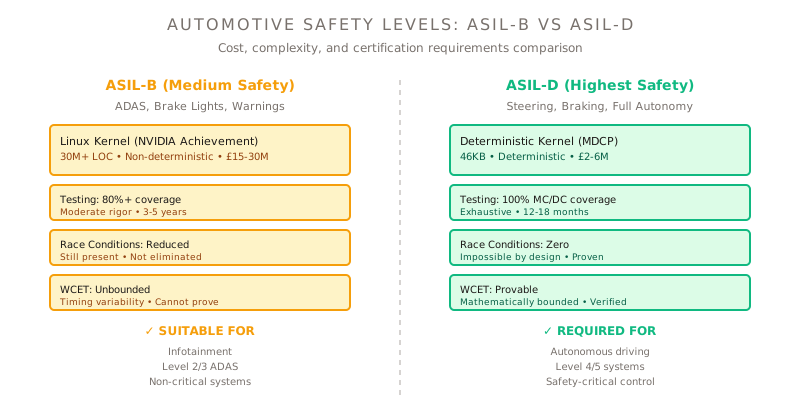
On December 23, 2025, NVIDIA announced a significant milestone: portions of their Linux kernel work have achieved ASIL-B certification for automotive safety-critical systems. This represents years of engineering effort and positions NVIDIA as a serious player in the autonomous vehicle market.
This achievement also clarifies an important industry question: what architectural approaches best support ASIL-D certification for Level 4/5 autonomous vehicles?
NVIDIA’s Achievement: Context and Significance
NVIDIA’s ASIL-B certification covers specific Linux kernel components used in their DRIVE automotive computing platform. This is genuinely impressive work—certifying any portion of the Linux kernel to automotive safety standards requires extraordinary discipline.
The certification likely covers:
- Memory management subsystems
- Scheduling components
- Device drivers for automotive peripherals
- Real-time extensions (PREEMPT_RT patches)
- Safety monitoring frameworks
Why this matters: The automotive industry is standardizing on Linux for infotainment, instrument clusters, and increasingly for ADAS (Advanced Driver Assistance Systems). NVIDIA’s certification demonstrates that Linux can meet automotive safety requirements—at least at ASIL-B.
The ASIL Hierarchy: What Separates B from D
ISO 26262 defines four ASIL (Automotive Safety Integrity Level) classifications:
ASIL-A: Low injury risk (e.g., rear lighting systems) ASIL-B: Medium injury risk (e.g., brake lights, ADAS warnings) ASIL-C: High injury risk (e.g., airbag deployment, ABS) ASIL-D: Highest injury risk (e.g., steering, braking, full autonomy)
The jump from ASIL-B to ASIL-D represents a substantial increase in certification rigour:
ASIL-D Requirements: ━━━━━━━━━━━━━━━━━━━━━━━━━━━━━━━━━━━━━━━━━
- Software unit testing: 100% coverage
- Integration testing: 100% MC/DC coverage
- Hazard analysis: Exhaustive FMEA
- Documentation: Complete traceability
- Verification: Independent V&V team
- Formal methods: Recommended for critical paths
- Hardware/software co-verification
- Estimated cost: Indicative £30-80M+
The key consideration: ASIL-D places strong emphasis on provable correctness and exhaustive failure mode analysis. For large, general-purpose systems, meeting these requirements introduces substantial technical and economic challenges.
Architectural Considerations for ASIL-D
General-purpose operating systems like Linux are optimised for throughput, flexibility, and broad hardware support. These design goals can create challenges when targeting ASIL-D certification:
1. Scheduling Determinism
Linux’s Completely Fair Scheduler (CFS) is designed for throughput and fairness, not determinism. Scheduling decisions depend on:
- System load (variable)
- Priority inheritance (complex state)
- CPU affinity masks (runtime configuration)
- Interrupt latency (hardware-dependent)
Consideration: Bounding worst-case execution time (WCET) can be challenging in systems with timing-dependent scheduling.
2. Concurrency and Synchronisation
Large kernels typically manage concurrency through synchronisation primitives. Even with PREEMPT_RT patches:
- Spinlocks introduce timing variability
- RCU (Read-Copy-Update) has variable grace periods
- Memory allocation timing varies with system state
- IRQ handling introduces timing variability
Consideration: Guaranteeing identical execution sequences across all operating conditions becomes difficult to demonstrate.
3. Code Size and Certification Scope
The Linux kernel exceeds 30 million lines of code. ASIL-D encourages:
- High code coverage in testing
- Formal verification of critical paths
- Complete traceability from requirements to implementation
- Exhaustive hazard analysis
Consideration: Certification cost and timeline scale with codebase size and complexity.
Why ASIL-D Matters for Autonomous Vehicles
Level 4/5 autonomous vehicles make safety-critical decisions:
- Emergency braking at highway speeds
- Lane changes in dense traffic
- Navigation through pedestrian-heavy areas
- Fail-safe transitions when sensors fail
These functions typically require ASIL-D certification. Regulators worldwide (NHTSA, UNECE, China’s MIIT) are increasingly examining these requirements. Understanding the architectural implications early can help inform design decisions.
Note: Cost, timeline, and regulatory outcomes discussed in this article are indicative estimates based on public industry discussions and certification programs. Actual results vary significantly by system architecture, deployment scope, and regulatory jurisdiction.
The Deterministic Execution Approach
Deterministic kernels take a different architectural approach: reproducibility by design.
Architecture Comparison
- Large codebase (30M+ lines)
- Throughput-optimised scheduler
- Relies on runtime synchronisation
- WCET: Challenging to bound precisely
- Replay: Difficult due to timing dependencies
- Well-suited for: ASIL-A/B applications
- Minimal codebase (~46KB)
- Tick-based deterministic execution
- Designed to avoid race conditions by construction
- WCET: Amenable to static analysis
- Replay: Supported by design
- Designed for: ASIL-D certification pathways
How Deterministic Execution Supports ASIL-D
1. Tick-Based Scheduling All decisions occur at discrete tick boundaries (typically 1ms). Given identical inputs and initial state, execution is designed to produce identical outputs.
2. Concurrency Model Single-threaded execution per tick reduces the synchronisation complexity that can make exhaustive analysis difficult.
3. Replay Capability Given initial state Σ₀ and event sequence E₁..Eₙ, final state Σₙ is designed to be reproducible:
Replay(Σ₀, E₁..Eₙ) → Σₙ (reproducible under defined conditions)This can support:
- Systematic testing of failure scenarios
- Post-incident reconstruction
- Formal verification of safety properties
- Stronger evidence for regulatory review
4. WCET Analysis Deterministic execution models are generally more amenable to static analysis for computing worst-case execution time bounds.
Comparative Economics
Note: The following cost estimates are indicative and based on publicly discussed certification programs. Actual costs depend heavily on system scope, existing infrastructure, and regulatory context.
Post-deployment considerations:
- Incident investigation complexity (timing-dependent)
- Regulatory review cycles
- Insurance and liability factors
DETERMINISTIC KERNEL APPROACH: ━━━━━━━━━━━━━━━━━━━━━━━━━━━━━━━━━━━━━━━━━━━━━━━━ ASIL-D certification: Potentially £2-6M (indicative) Timeline: Potentially 12-24 months
Post-deployment considerations:
- Incident investigation (replay-assisted)
- Regulatory review (reproducibility evidence)
- Insurance (demonstrable safety properties)
Different architectures present different cost/benefit profiles depending on safety requirements and deployment context.
Complementary Architectures
NVIDIA’s ASIL-B Linux kernel and deterministic kernels like MDCP can be complementary technologies for different safety tiers:
Linux (ASIL-B):
- Infotainment systems
- HMI (Human-Machine Interface)
- ADAS Level 2/3 features
- Navigation and connectivity
- Cost-effective for general computing workloads
Deterministic Kernels (ASIL-D pathway):
- Autonomous driving controller
- Steering and braking actuation
- Sensor fusion and decision-making
- Safety monitoring and failsafe
- Designed for Level 4/5 autonomy requirements
A combined architecture might leverage both:
- Linux handles rich UI and connectivity
- Deterministic kernel handles safety-critical control
- Hypervisor ensures isolation
- Combined solution addresses different regulatory tiers
The Path Forward
NVIDIA’s work validates that Linux can meet automotive safety standards at ASIL-B. This is valuable for the significant portion of automotive software that operates at this safety level.
For functions that require ASIL-D—the code that makes safety-critical decisions—deterministic execution models offer architectural advantages that can simplify the path to certification. The reproducibility, traceability, and bounded execution characteristics align well with ASIL-D requirements.
NVIDIA’s achievement moves the industry forward. It clarifies where general-purpose kernels excel and where alternative architectures may offer advantages for the highest safety levels.
Conclusion
The autonomous vehicle industry benefits from multiple architectural approaches:
NVIDIA’s ASIL-B Linux work demonstrates that general-purpose kernels can meet automotive safety standards and provides a strong foundation for ADAS and infotainment.
Deterministic execution platforms offer architectural characteristics that can simplify ASIL-D certification for safety-critical autonomous functions.
These approaches are complementary. The organisations that understand where each architecture fits best will be well-positioned as the industry evolves toward higher levels of autonomy.
The technology landscape is maturing. The architectural choices made today will shape the certification outcomes of tomorrow.