Note: This article discusses numerical edge cases in statistical monitoring. Specific implementations require validation appropriate to their deployment context.
Every programmer learns to check for division by zero. It’s the canonical example of defensive coding—the operation that crashes programs, corrupts calculations, and appears in every introductory textbook. Yet in statistical monitoring systems, this simple edge case manifests in a form that is both mathematically subtle and practically dangerous: the zero-variance problem.
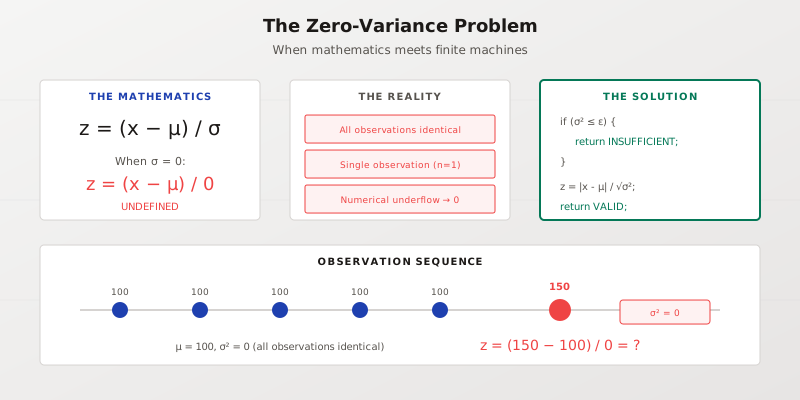
The issue arises in anomaly detection. To determine whether an observation is unusual, we often compute how many standard deviations it lies from the mean—the z-score. The formula is elegant: z = (x − μ) / σ. But when variance is zero, standard deviation σ is also zero, and the formula demands division by nothing.
This is not a theoretical curiosity. It occurs in real systems, under realistic conditions, with consequences that range from crashed processes to silent failures to incorrect safety decisions.
When Variance Vanishes
Zero variance sounds impossible. Surely real-world data has some variability? But the conditions that produce it are surprisingly common.
Identical observations. A system that heartbeats every 100 milliseconds with perfect regularity will produce a sequence: 100, 100, 100, 100, 100. The mean is 100. The variance is 0. When the first anomalous value arrives—say, 150 milliseconds—the z-score calculation divides by zero.
Insufficient data. With a single observation, variance is undefined (or zero, depending on the formula). A monitoring system that has seen only one heartbeat cannot compute meaningful statistics. Yet the second heartbeat will arrive, and the system must respond.
Numerical underflow. Even when true variance is positive, floating-point arithmetic can produce zero. If observations are very close together relative to machine precision, accumulated rounding errors can collapse variance to exactly 0.0. The mathematics says variance is tiny; the computer says it’s nothing.
Clamped or quantised inputs. Sensors with limited resolution, systems that round to integers, or processes that saturate at limits can produce streams of identical values. A temperature sensor stuck at its maximum reading reports the same value indefinitely. Variance: zero.
Each of these scenarios is realistic. Each produces the same computational crisis: a formula that mathematics defines perfectly, but machines cannot evaluate.
Why It Matters for Safety
In ordinary software, division by zero produces an exception, a crash, or a special value like infinity or NaN. The failure is visible. Someone notices.
In safety-critical monitoring, the failure modes are worse. Consider an anomaly detector protecting a cardiac rhythm monitor. The detector computes z-scores on inter-beat intervals. During a period of perfect regularity—a healthy, stable rhythm—variance approaches zero. Then an arrhythmia occurs. The interval changes dramatically.
The detector should flag this as a severe anomaly. Instead, it divides by zero. What happens next depends on the implementation:
- Crash. The monitoring process terminates. The patient is unprotected until someone restarts it.
- NaN propagation. The z-score becomes NaN, which propagates through subsequent calculations. Comparisons with NaN return false. The anomaly is never detected.
- Infinity. The z-score becomes positive infinity. If the threshold check uses greater-than comparison, infinity exceeds any threshold, triggering a perpetual alarm. If it uses floating-point equality, infinity may not match expected values, causing silent failure.
- Undefined behaviour. In languages like C, integer division by zero is undefined. The program may do anything—continue with garbage values, crash, or corrupt memory.
None of these outcomes is acceptable. The zero-variance problem transforms a period of perfect health—stable, regular operation—into a vulnerability that manifests precisely when anomalies occur.
The Mathematical Reality
The z-score formula assumes a population with positive variance. When variance is zero, every observation equals the mean. In this degenerate case, the concept of “standard deviations from the mean” is meaningless—there is no scale against which to measure deviation.
This is not a flaw in the mathematics. It is a boundary condition where the statistical model does not apply. The formula z = (x − μ) / σ is valid when σ > 0. When σ = 0, we are outside the domain of the function.
Mathematicians handle this by stating preconditions: “Let σ > 0.” Programmers do not have this luxury. The input arrives regardless of whether it satisfies preconditions. The code must respond.
Three Inadequate Solutions
Before examining what works, consider what doesn’t.
Assume it won’t happen. This is the most common approach, and the most dangerous. Developers reason that real data always has some variance, so the edge case is theoretical. This assumption holds until it doesn’t—typically in production, under load, with consequences.
Add a small epsilon. Replace σ with σ + ε to avoid exact zero. This creates a different problem: the choice of ε is arbitrary, and small ε values produce enormous z-scores from tiny deviations. A system might flag a 101-millisecond heartbeat (after a run of 100s) as a catastrophic anomaly because (101 - 100) / 0.0001 = 10,000 standard deviations.
Clamp the z-score. Compute the z-score normally, then clamp results to some maximum value. This hides the symptom without addressing the cause. The z-score of 10,000 becomes 10 (or whatever the clamp), but the underlying numerical instability remains. Different observations produce the same clamped output, losing information.
Each of these approaches either ignores the problem or patches it without understanding. They lead to systems that appear to work but fail under specific, reproducible conditions.
A Principled Solution: Epistemic Honesty
The correct approach is epistemic honesty: acknowledge when the calculation is not meaningful, and represent that explicitly in the output.
A statistical calculation should return its result only when the computation is valid. When preconditions are not met, it should return a distinct status indicating insufficient information.
In practice, this means the z-score function returns two things: a validity flag and a value. The value is meaningful only when the flag indicates success.
typedef struct {
    bool   valid;
    double z;
} zscore_result_t;

zscore_result_t compute_zscore(double x, double mu, double variance) {
    zscore_result_t result;

    if (variance <= EPSILON) {
        result.valid = false;
        result.z     = 0.0;  // Placeholder, not meaningful
        return result;
    }

    result.valid = true;
    result.z     = fabs(x - mu) / sqrt(variance);
    return result;
}
The caller must check valid before using z. This is not optional error handling that might be skipped—it is the function’s contract. A z-score that cannot be computed is not an error to be caught; it is information to be acted upon.
Integrating with State Machines
In the c-from-scratch framework, this pattern integrates with the state machine architecture. The Baseline module (see Statistics as State Transitions) has three states: LEARNING, STABLE, and DEVIATION.
The LEARNING state exists precisely for this scenario. While variance is insufficient—whether because we have too few observations or because all observations are identical—the system remains in LEARNING. It cannot transition to STABLE or DEVIATION because the statistical basis for those judgments does not exist.
Baseline state transitions:

LEARNING:
  - variance > threshold → STABLE (if z-score normal)
  - variance > threshold → DEVIATION (if z-score abnormal)
  - variance ≤ threshold → LEARNING (stay, insufficient data)

STABLE:
  - z-score exceeds threshold → DEVIATION
  - variance drops to zero → LEARNING (revert, lost statistical basis)

DEVIATION:
  - z-score returns to normal → STABLE
  - variance drops to zero → LEARNING (revert)
The transition “variance drops to zero → LEARNING” handles the case where a previously variable signal becomes constant. The system does not crash or produce garbage; it acknowledges that it has lost the ability to make statistical judgments and reverts to learning mode.
This is a total function in the technical sense: every input has a defined response. The zero-variance case is not an exception to be caught but a state to be handled.
The EPSILON Question
The guard condition uses variance <= EPSILON rather than variance == 0. This raises an obvious question: what is EPSILON?
The answer depends on context, but the principle is clear: EPSILON represents the threshold below which variance is numerically indistinguishable from zero for the purposes of the calculation.
For IEEE 754 double-precision floating point, machine epsilon is approximately 2.2 × 10⁻¹⁶. But this is not the right choice. The relevant threshold is the variance below which z-score calculations become numerically unstable—where small changes in input produce large changes in output due to division by a near-zero value.
A practical choice is to set EPSILON relative to the expected scale of the data. If observations are in the range of 100 milliseconds, a variance of 10⁻¹⁰ is effectively zero. If observations are in the range of nanoseconds, the threshold differs.
The c-from-scratch Baseline module exposes this as a configuration parameter, allowing it to be tuned for the deployment context. The default is conservative—treating very small variance as insufficient—with documentation explaining when and how to adjust it.
Compositional Implications
In a composed system like the Timing Health Monitor (see Composition Without Compromise), the zero-variance handling propagates through the composition.
The data flow is: events → Pulse → Δt → Baseline → composed state.
When Baseline is in LEARNING (due to zero variance or insufficient observations), the composed Timing state is INITIALIZING. The system cannot claim HEALTHY or UNHEALTHY because it lacks the statistical evidence to distinguish them.
This is the correct epistemic position. A monitoring system that has seen only identical heartbeat intervals cannot know whether the next different interval is normal variation or a dangerous anomaly. Rather than guess, it acknowledges uncertainty.
When variance becomes sufficient—when the signal shows enough variation to establish a baseline—the system transitions to STABLE (or DEVIATION, if the current observation is anomalous). The transition is driven by evidence, not time or arbitrary thresholds.
Invariants and Testing
The zero-variance handling introduces testable invariants:
INV-ZV1: (variance ≤ EPSILON) → (zscore.valid == false)
INV-ZV2: (state == STABLE || state == DEVIATION) → (variance > EPSILON)
INV-ZV3: (variance drops below EPSILON) → (next_state == LEARNING)
These invariants can be verified through contract tests and fuzz testing. The c-from-scratch Baseline module includes tests that specifically target the zero-variance boundary:
- Sequences of identical values
- Sequences where variance decreases to zero over time
- Sequences that alternate between zero and non-zero variance
- Boundary cases at exactly EPSILON
Fuzz testing with random sequences confirms that the invariants hold regardless of input patterns. The system never divides by zero, never produces NaN, and never crashes—because the edge case is handled by design, not by accident.
Beyond Z-Scores
The zero-variance problem is an instance of a broader pattern: mathematical formulas that are undefined at boundary conditions. Other examples in monitoring systems include:
- Logarithms of zero or negative values — log-based metrics fail when the input is non-positive
- Ratios with zero denominators — efficiency metrics, rates, and percentages all divide
- Inverse operations at singularities — matrix inversion fails for singular matrices
The solution pattern is the same: guard the computation, return validity information, and design the state machine to handle the “insufficient data” case explicitly. This is not defensive programming in the sense of catching errors; it is honest programming in the sense of representing what the computation can and cannot tell us.
Conclusion
The zero-variance problem illustrates a general truth: mathematics describes ideal relationships, while machines compute with finite precision under real-world constraints. The gap between mathematical elegance and computational reality is where bugs live.
The z-score formula z = (x − μ) / σ is mathematically perfect. It is also computationally incomplete—it does not specify behaviour when σ = 0. That specification is the programmer’s responsibility.
The principled solution is not to avoid the edge case or to patch it with arbitrary constants. It is to acknowledge it explicitly: when variance is insufficient, the z-score cannot be computed, and this fact should be represented in the output. State machines that consume this output should have explicit states for “insufficient information” and transitions that handle the boundary.
This approach aligns with the broader philosophy of the c-from-scratch project: make the mathematics explicit, handle all cases, and let the code reflect what we actually know. When we know nothing—when variance is zero—the code should say so.
As with any architectural approach, suitability depends on system requirements, risk classification, and numerical context. But for safety-critical monitoring where silent failures are unacceptable, epistemic honesty is not optional. The zero-variance problem is not an edge case to be dismissed; it is a boundary condition to be respected.