Alongside our commercial safety-critical systems work, we contribute to the open source community that shaped us. The projects listed here apply the same principles as our production systems: mathematical rigour, minimal dependencies, and code designed to prove its own correctness.
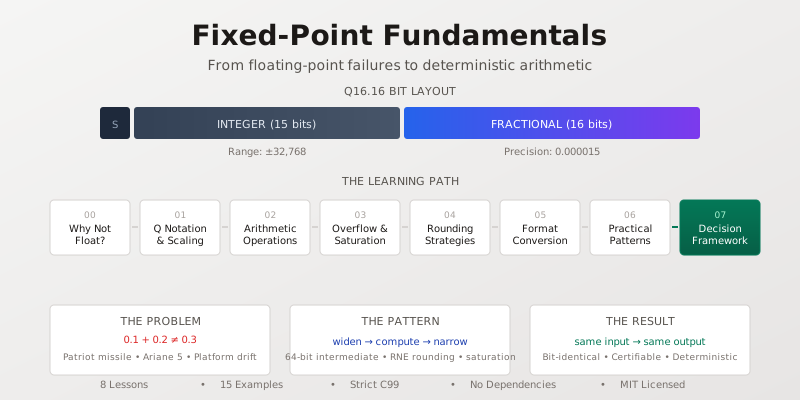
Fixed-Point Fundamentals
Learn fixed-point arithmetic from first principles — because 'close enough' isn't deterministic
certifiable-bench
Performance benchmarking for deterministic ML — because 'fast' means nothing if you can't prove it's correct
certifiable-harness
End-to-end test harness for deterministic ML — because 'it works on my machine' isn't certifiable
certifiable-verify
Pipeline verification for the certifiable-* ecosystem — because 'we checked it manually' isn't certifiable
certifiable-monitor
Deterministic runtime monitoring — because 'the model drifted' isn't certifiable
Certifiable Deploy
Deterministic model packaging and cryptographic attestation — because 'trust me, it's the right model' isn't certifiable
Certifiable Quant
Deterministic model quantization with formal error certificates for safety-critical ML
C-From-Scratch
Learn to build safety-critical systems in C — mathematical rigour, not 'Hello World'
Certifiable Data
Deterministic data pipelines for safety-critical ML — because 'we shuffled the data' isn't reproducible
C-Sentinel
Semantic observability for UNIX systems — lightweight system probing with explainable risk scoring
10 of 12 projects
"The open source outlives us."
— William Murray