Training machine learning models is inherently non-deterministic. Floating-point operations vary across platforms. Parallel reductions produce different results each run. Data shuffling depends on random number generators that aren’t truly random.
For safety-critical systems, you cannot certify what you cannot reproduce.
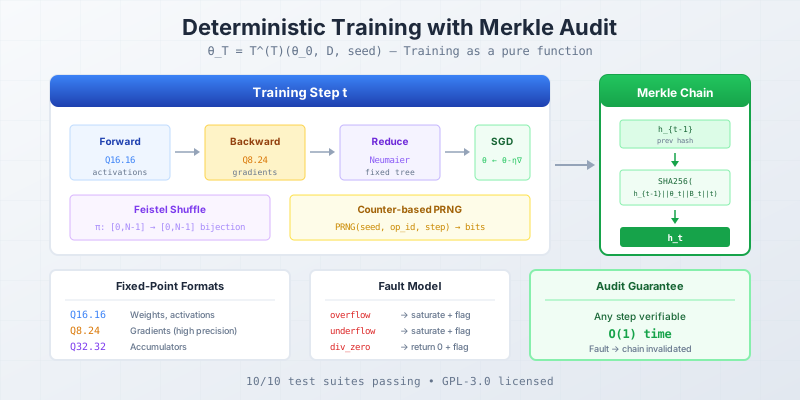
certifiable-training redefines training as a deterministic state evolution. Training becomes a pure function: θ_T = T^(T)(θ_0, D, seed). Given the same initial weights, data, and seed, you get the same final model — bit for bit, every time, on every platform.
The Four Mechanisms
1. Fixed-Point Arithmetic
Q16.16 for weights, Q8.24 for gradients, Q32.32 for accumulators. Same math, same result, every platform.
| Format | Use Case | Range | Precision |
|---|---|---|---|
| Q16.16 | Weights, activations | ±32768 | 1.5×10⁻⁵ |
| Q8.24 | Gradients | ±128 | 5.9×10⁻⁸ |
| Q32.32 | Accumulators | ±2³¹ | 2.3×10⁻¹⁰ |
The higher precision for gradients prevents small updates from being rounded away. The wide accumulators prevent overflow during summation.
2. Deterministic Reduction
Parallel gradient reduction is a major source of non-determinism. The order of floating-point additions affects the result. Different thread scheduling produces different sums.
certifiable-training uses fixed tree topology with Neumaier compensated summation:
// Fixed reduction tree — same topology every time
//       [sum]
//      /     \
//   [a+b]   [c+d]
//   /  \    /  \
//  a    b  c    d
The tree topology is determined at compile time, not runtime. Combined with compensated arithmetic, the reduction is deterministic regardless of hardware parallelism.
3. Reproducible “Randomness”
Data shuffling and dropout require random numbers. But standard PRNGs maintain internal state that varies with execution order.
We use counter-based PRNG: PRNG(seed, op_id, step) → deterministic bits. The output depends only on the inputs, not on hidden state. Same seed produces same sequence.
For data shuffling, we use a Cycle-Walking Feistel network that provides true bijection for any dataset size:
π: [0, N-1] → [0, N-1] (one-to-one and onto)This isn’t “shuffle and hope” — it’s a cryptographic permutation with proven properties.
4. Merkle Audit Trail
Every training step produces a cryptographic commitment:
h_t = SHA256(h_{t-1} || H(θ_t) || H(B_t) || t)Where:
h_{t-1}is the previous hash (chain link)H(θ_t)is the hash of current weightsH(B_t)is the hash of the current batchtis the step number
Any step can be independently verified. If you claim “model X was produced by training Y,” the Merkle chain proves it — or proves you’re lying.
What’s Implemented
All core modules complete — 10/10 test suites passing:
| Module | Description |
|---|---|
| DVM Primitives | Fixed-point arithmetic with fault detection |
| Counter-based PRNG | Deterministic pseudo-random generation |
| Compensated Summation | Neumaier algorithm for precision |
| Reduction Tree | Fixed-topology parallel reduction |
| Forward Pass | Q16.16 activations (ReLU, sigmoid, tanh) |
| Backward Pass | Q8.24 gradient computation |
| Optimizers | SGD, Momentum, Adam |
| Merkle Chain | SHA256 audit trail with checkpoints |
| Data Permutation | Cycle-Walking Feistel bijection |
| Bit Identity | Cross-platform reproducibility tests |
The Fault Model
Every arithmetic operation can overflow, underflow, or divide by zero. Traditional code either ignores these (undefined behaviour) or throws exceptions (non-deterministic control flow).
certifiable-training uses sticky fault flags:
typedef struct {
    uint32_t overflow    : 1;  // Saturated high
    uint32_t underflow   : 1;  // Saturated low
    uint32_t div_zero    : 1;  // Division by zero
    uint32_t domain      : 1;  // Invalid input
    uint32_t precision   : 1;  // Precision loss
} ct_fault_flags_t;
Operations saturate rather than overflow. Faults are recorded but execution continues deterministically. If any fault occurs during a training step, the Merkle chain is invalidated — you know something went wrong, and you know exactly when.
Usage Example
#include "ct_types.h"
#include "forward.h"
#include "backward.h"
#include "optimizer.h"
#include "merkle.h"

// All buffers pre-allocated
fixed_t weights[784 * 128];
grad_t gradients[784 * 128];
ct_fault_flags_t faults = {0};

// Initialize Merkle chain
ct_merkle_ctx_t merkle;
ct_merkle_init(&merkle, &weights_tensor, config, config_size, seed);

// Training step
ct_forward_linear(&layer, input, output, &faults);
ct_backward_linear(&layer, grad_in, &faults);
ct_sgd_step(&sgd, weights, gradients, size, &faults);

// Commit to audit trail
ct_merkle_step(&merkle, &weights_tensor, indices, batch_size,
               &step_record, &faults);

if (ct_has_fault(&faults)) {
    // Training step invalid — chain not extended
}
Why It Matters
Regulatory Compliance
IEC 62304 (medical devices) requires traceable, reproducible software. ISO 26262 (automotive) demands provable behaviour. DO-178C (aerospace) requires complete requirements traceability.
“We trained a neural network and it works” satisfies none of these. “Here is the cryptographic proof that this model was produced by this exact training process” is a foundation for certification.
Incident Investigation
When an autonomous vehicle makes a bad decision, investigators need to understand why. With Merkle-chained training, you can prove exactly what training data and process produced the model. You can replay any training step and verify it matches the logged hash.
Model Provenance
In an era of model theft and supply chain attacks, proving where a model came from matters. The Merkle chain provides cryptographic attestation of model lineage.
The Certifiable Pipeline
certifiable-training is part of a complete deterministic ML pipeline:
| Project | Purpose |
|---|---|
| certifiable-data | Deterministic data loading, shuffling, augmentation |
| certifiable-training | Deterministic training with Merkle audit |
| certifiable-inference | Deterministic inference |
The chain is complete: deterministic data → deterministic training → deterministic inference. End-to-end reproducibility.
Getting Started
git clone https://github.com/williamofai/certifiable-training
cd certifiable-training
mkdir build && cd build
cmake ..
make
make test
Expected output:
100% tests passed, 0 tests failed out of 10
Total Test time (real) = 0.04 sec
Documentation
- CT-MATH-001.md — Mathematical foundations
- CT-STRUCT-001.md — Data structure specifications
- docs/requirements/ — SRS documents with full traceability
Training as a pure function. Merkle-chained proof. GPL-3.0 licensed.